
There is a growing recognition that progress towards sustainability, by its very nature, demands an understanding and engagement with different disciplines. Often, sustainability related learning is assumed to be relevant only to certain disciplines. However, it is becoming increasingly evident that a climate and sustainability lens needs to inform everyone’s work and worldview, beyond the confines of only those working in specific sectors.
Sustainable development and climate change are no longer challenges of the distant future—they are harsh realities shaping our world today. And it is imperative that students working towards undergraduate and graduate degrees – soon to become working professionals stepping into future leadership roles – enter the workforce equipped to take informed actions and make decisions that positively impact their surroundings.
In Aug–Sep 2024, the Bengaluru Sustainability Forum(BSF), in collaboration with CMR University School of Architecture and Arathi Hanumanthappa, conducted a six-part lecture series to help final-year students understand the interlinkages between urban systems and sustainability in practice. Through expert-led sessions and field mapping, students were encouraged to apply a climate and sustainability lens to how they observe, think about, and engage with their surroundings. This experience validated the need for such interventions and the student’s receptiveness to this knowledge.
For young people, sustainability is not an abstract issue but represents strong and central lived concerns. In fact, a recent survey found that climate change takes precedence for Indian Millennials, with 26 percent emphasising its significance. The same survey reveals that climate concern is deemed important by 79 percent of Indian Gen Zs and 81 percent of Indian Millennials.
For the youth of today, grappling with the complex interconnectedness of the various aspects of sustainability entails going beyond a theoretical /academic knowledge to understanding its application in their everyday lives and in their surroundings. As they consume information and build their worldview primarily through the digital world, it is essential that their college education equips them with the necessary knowledge, skills, and tools to interpret, analyse, and discern the information they encounter.
Ultimately, meaningful change will come only when individuals begin to apply a sustainability perspective to every decision and action—understanding the trade-offs, evaluating impacts, and distinguishing between superficial “green” solutions and those with true transformative potential. Education must therefore empower learners with the tools to think critically, act responsibly, and make informed choices that contribute to a more sustainable and just future.
Educators today play a key role in helping students connect to the real world and make sense of it; while also building their capacity to make a difference. At the same time, educators themselves need to reflect on how to internalise a climate and sustainability perspective and bring it into their own work. Their inputs will be critical to help students navigate their understanding beyond their respective disciplines – in an integrated and constructive manner, helping them avoid being overwhelmed by the magnitude of issues, and to identify how they can contribute to solutions that address issues of environmental and social justice related to sustainability.
We also believe that the responsibility for sustainability education lies not just with the individual teacher/institution but with a larger network of stakeholders, coming together to collaborate and support one another in this endeavour.
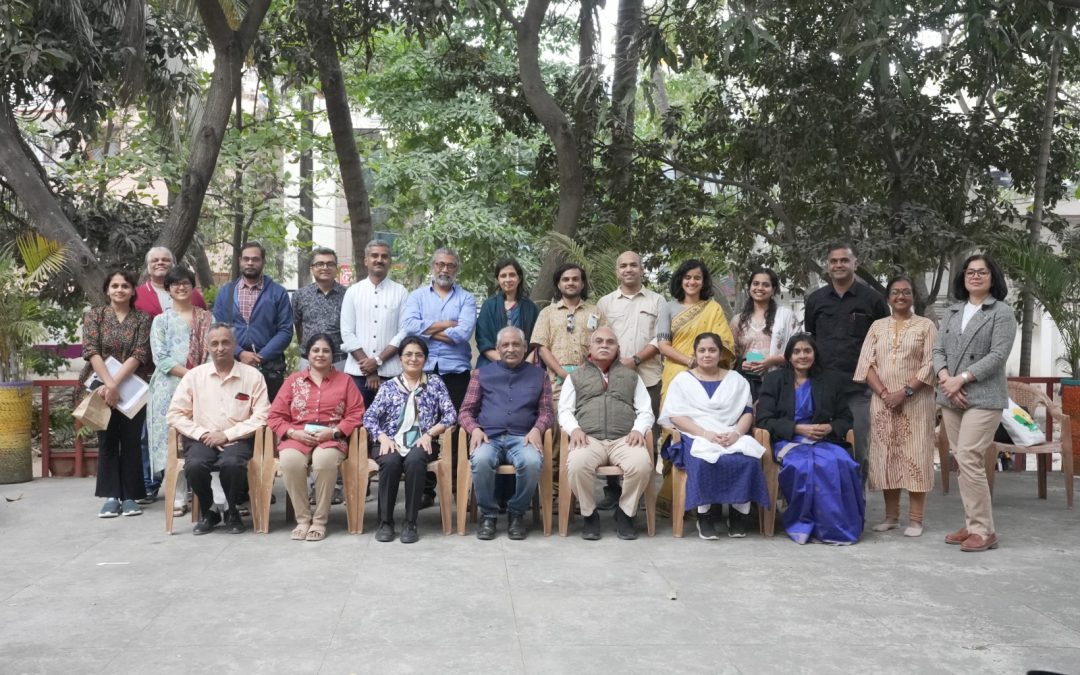
The collective deliberation on January 9th, 2026 was one step in this direction. Some of the questions it attempted to reflect on included:
- What does embedding sustainability education in your teaching mean for you?
- What is at the core of the imaginations that students must take away?
- What resources and approaches have been most useful for you in terms of producing transformative learning etc.
- What have your experiences been with developing interdisciplinary curricula and integrating it in your teaching?
- What are the main challenges you face?
- What are some of the innovative pedagogical approaches you have developed and experimented with?
- How can you develop a sense of agency and optimism for young students on grim issues around sustainability?
__